How to show up in ChatGPT and AI agent answers — and why llms.txt won’t get you there
GEO without the myths: what gets a site read and cited by ChatGPT, Google and AI agents, what the data says about llms.txt, and why MCP matters.
Disappearing from Google is bad. Disappearing from AI answers may be worse, because more and more people never even see the list of links. According to OpenAI, search volume inside ChatGPT is already equal to about 20% of Google’s. And when Google shows an AI summary at the top, clicks to websites drop by almost 40%.
The question every site owner is asking is: how do I show up in those answers? And the answer most often sold out there, “create an llms.txt,” is exactly the one the data debunks. In this article I separate what works from what is myth, and explain why your site needs to be ready to be read by humans, and also to be read, cited and operated by agents.
Read also: ChatGPT already handles 1/5 of Google’s searches, and AI search is drying up website traffic · will websites stop mattering with AI agents?
What GEO is (and what it is not)
GEO, short for generative engine optimization, is the work of getting your content found, understood and cited by AI systems: ChatGPT with search, Perplexity, Google’s AI summaries and the agents that carry out tasks on people’s behalf.
It is not a discipline separate from SEO. It is SEO with a different reader at the end of the line. Almost everything that helps a search crawler understand your page helps an AI too. The difference is that the AI does not give you a position in a list. It cites you, or it does not.
The llms.txt myth
llms.txt is a Markdown file, proposed in 2024, that summarizes a site for language models. It became a craze: plugins, audit tools and agencies started selling it as “the robots.txt for AI.” The numbers tell a different story.
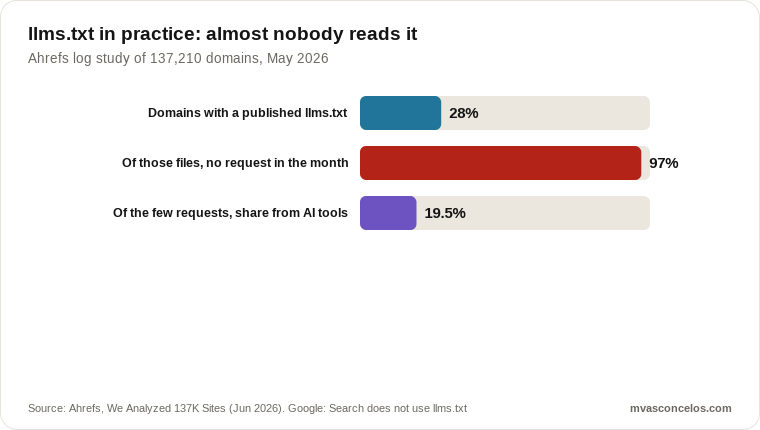
- Ahrefs analyzed the logs of 137,210 domains: 97% of llms.txt files received no requests at all in May 2026. Not from bots, not from people.
- OtterlyAI measured for 90 days: out of more than 62,000 AI bot visits, 84 went to llms.txt, about 0.1%.
- Google says, in its own documentation on AI features in Search, that it does not use llms.txt and that creating the file neither helps nor hurts.
So who reads the file? Mostly coding agents, like Claude Code, when someone points them to it. That is why llms.txt makes sense on technical documentation sites. I keep one on this site because it costs nothing on a static site, but I do not sell it as a citation factor, because it is not one.
What actually gets a site cited
There is no shortcut, but there is a set of things that really count:
- Let the right bots in. If your
robots.txtblocks AI search crawlers (like ChatGPT’s OAI-SearchBot or PerplexityBot), you do not show up. Blocking training bots is a choice; blocking search bots is disappearing. - Serve real HTML. Many AI crawlers do not run JavaScript. If the content only appears after the browser runs the script, the page is empty to them. Static sites, like the ones built with Astro, serve the text ready to read.
- Answer questions directly. A paragraph that answers the question right at the start, followed by the details, is exactly the format an AI can extract and cite. That is why this blog has FAQ sections.
- Have data and sources. AI cites whoever has numbers, dates and sources. Generic text gets diluted in the answer; an original data point becomes a citation.
- Make it clear who you are. Structured data (schema.org) stating who the person or company is, where they operate and which profiles are official helps the AI avoid confusing you with another entity with a similar name. I did this on this site precisely because there is a company with a name almost identical to my domain.
- Be in the index that feeds the AI. Many search-backed answers rely on traditional search engine indexes behind the scenes. Solid SEO is still the foundation.
MCP: the next step is being operated, not just read
So far we have talked about being read and cited. The next step is being used by agents. An agent that books an appointment, requests a quote or checks a price needs a standard way to talk to your site.
That standard already exists. MCP (Model Context Protocol), created by Anthropic, became an open standard: it was donated to the Agentic AI Foundation, part of the Linux Foundation, in December 2025, and its SDKs top 97 million downloads a month. ChatGPT, Claude, Gemini, Copilot and the main coding tools already speak MCP.
The WordPress world noticed too: WordPress 7.0 shipped an AI client in core and an official MCP adapter, and Cloudflare launched EmDash, a CMS built on Astro with a native MCP server.
In practice, an agent-ready site exposes its main actions (booking, requesting a quote, checking availability) through a clear API, which can be offered via MCP. The booking system on this site, for example, already works through an API, and that is the foundation for it.
Checklist: is your site ready for AI search?
- Does your
robots.txtallow AI search crawlers? - Does the main content appear in the HTML, without depending on JavaScript?
- Does each page answer a clear question right at the start?
- Are there data, dates and sources worth citing?
- Does your structured data say who you are and which profiles are official?
- Do the site’s key actions have an API an agent could use?
- Is
llms.txtthere only as a cheap bonus, not as a strategy?
Frequently asked questions
How do I show up in ChatGPT answers?
Allow ChatGPT’s search crawlers in your robots.txt, serve your content as HTML, answer questions directly, bring data with sources and keep up solid traditional SEO, since search-backed answers rely on search indexes.
What is GEO?
It is generative engine optimization: the work of getting your content found, understood and cited by ChatGPT, Perplexity, Google’s AI summaries and agents. In practice, it is SEO designed for a reader that summarizes and cites instead of listing links.
Does llms.txt actually work?
For AI search, the data says no: 97% of files received no requests in an Ahrefs study of 137,000 domains, and Google states that it does not use the file. It is useful for coding agents on documentation sites.
What is MCP and why does it matter for my site?
The Model Context Protocol is an open standard that lets AI agents use tools and services. With it, an agent can book, look something up or request a quote on your site. It already has more than 97 million monthly downloads and support across the major AIs.
My verdict
There is no magic file that makes AI cite you. There is the same old work, with a new reader: useful content, quick to read, with data and sources, on a site that serves clean HTML and makes it clear who you are. And, more and more, a site that does not just inform, but lets agents act.
The question for 2027 is not just “does my site show up on Google?” It is: is my site ready to be read by humans, and to be read, cited and operated by agents?
Sources
- ChatGPT and search volume: Search Engine Roundtable (OpenAI statement, Nov 2026)
- AI Overviews and clicks: PPC Land, randomized experiment by Agarwal and Sen
- llms.txt: Ahrefs and Optimizely, summary of the log studies
- MCP: Anthropic, donation of MCP to the Agentic AI Foundation
- WordPress 7.0 and EmDash: GoDaddy and InstaWP