Will websites stop mattering because of AI agents? 7 things to get right in 2027
Zero-click searches, AI Mode, Gemini Spark and agents that book for you. What is true, what is hype, and what a business website needs to have in 2027.
There is a growing trend in the market: the idea that websites will “stop mattering” within three years. It gained weight when The Economist published “AI is killing the web. Can anything save it?” in July 2025, and it has been repeated in talks, posts and reports ever since. The arguments: more than half of Google searches end without a click, Google’s own CEO said 2027 is the year of agents, and soon an AI assistant will research, compare and hire services for you, talking directly to the business’s “agent”.
I build websites for a living, so I checked. Conclusion: this trend gets the direction right and the speed wrong. And some of the claims are just plain wrong. Below I separate fact from hype, and lay out what I would do on a business website to be well positioned in 2027.
Read also: AI search and the end of the click and how to show up in ChatGPT’s answers
What is true
Zero-click searches have grown. The 58% figure, the one most repeated in this debate, comes from a 2024 SparkToro study. The most recent measurement, from SparkToro with Similarweb, shows 68% of US Google searches ending without a click between January and April 2026, up from about 60% in 2024.
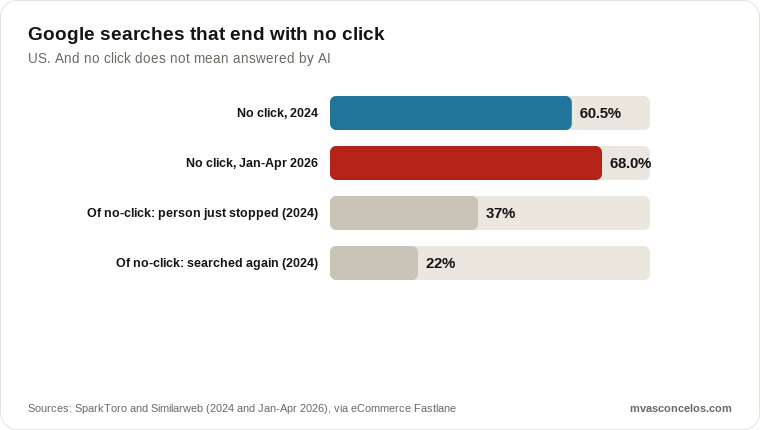
But careful: zero-click is not the same as “answered by AI”. In the 2024 data, 37% of those searches ended with the person simply stopping and 22% with them searching again. AI summaries do take clicks (I showed an experiment with a 39.8% drop in this article), but they are not the only reason.
Google really is turning into an “agent manager”. In an April 2026 interview, Sundar Pichai said search will evolve into something that coordinates agents, and pointed to 2027 as a turning point for tasks outside of programming to start being done by agents.
Personal agents already exist. Gemini Spark, announced at Google I/O in May 2026, is an agent that works 24 hours a day, handles email and calendar, and connects to other services. And Google’s AI Mode already finds and books restaurant reservations, tickets and appointments at salons and beauty clinics through partners like OpenTable and Booksy, as an experiment in the US.
Google asked for content that is not a “commodity”. Google’s official guide to AI search, published in May 2026, draws a line between generic content, which anyone could write, and content with real experience and a point of view of its own. The first kind tends to vanish from answers.
What is hype
“Websites won’t matter in three years.” Gemini Spark is in beta, US only, and for people paying for Google’s most expensive subscription. Pichai himself said only a tiny fraction of the world lives that future today. And OpenAI, which launched in-chat purchasing in 2025, walked it back in March 2026. Agents will grow, but they will not replace the web in 2027.
Google’s “knowledge catalog”. One of the most repeated claims is that businesses need a Google “Knowledge Catalog” so agents can find them. Knowledge Catalog exists, but it is a Google Cloud product for large companies to organize internal data (formerly Dataplex). It is not a public directory that assistants check to find a service provider. The idea behind it, having your business data organized, is good. The product name has nothing to do with it.
“Rankings and engagement won’t matter.” The same Google guide says optimizing for AI search is still SEO: AI Overviews and AI Mode use the same index and the same quality systems. And it says to ignore tricks like llms.txt, which I looked at here.
“Agent talking to agent” tomorrow. Google’s A2A protocol has existed since 2025 and lets agents from different companies talk to each other. But today that is infrastructure for large platforms, not something a local business needs to set up next month.
What actually changes for your business website
The website does not die. Its job changes. It used to be a storefront for people; now it also needs to be a reliable data source for machines: search engines, assistants and, more and more, agents that read, compare and act.
In practice, that favors fast sites with clean HTML, structured data and complete information. That is why I now migrate WordPress sites to modern technologies like Astro and Cloudflare, which gain on performance and are built from the start to connect with AI agents.
7 things to get right in 2027
1. Publish a pricing reference
People ask AI “how much does it cost”. If your site says nothing, the AI cites whoever does. You do not need to publish your whole price list: a price range per service, what makes the price go up or down, and real examples are enough. I do this on my site migration page, with the comparison of hosting and plugin costs.
2. Offer real online booking
A “contact us” form is not a calendar. An agent cannot book anything through a form that depends on someone replying the next day. Have visible available time slots and automatic confirmation, ideally in a system with an API or integrations with other platforms. On this site, the booking page shows open slots and confirms on the spot.
3. Turn real customer questions into content
Every customer call, email or message is a topic. “My AC turns on but doesn’t cool, what could it be?” is worth more than “7 summer tips”. Write down the questions that come in, answer them publicly with your own experience, and keep a living FAQ page. That is what Google calls non-commodity content.
4. Keep your business data in one place
Services, service area, hours, prices, policies, credentials, reviews and FAQs, consistent across your site, your Google Business Profile and your social accounts. Use structured data (schema.org) for the basics: business, services, FAQs. That is the “knowledge catalog” everyone talks about, just in the right place: your website.
5. Let the right bots in, and measure
Check in your robots.txt that Googlebot, Bingbot and OAI-SearchBot (which puts sites in ChatGPT search) can access the site. In GA4, track traffic arriving with utm_source=chatgpt.com and from other assistants. What you don’t measure turns into guesswork.
6. Stop paying for generic content
If your agency delivers posts like “Happy Earth Day” and copy any AI could write, you are paying for something Google and the assistants will ignore. Fewer posts, more content with a real case, a real number and a real opinion.
7. Build a channel that is yours alone
With fewer clicks coming from search, the direct relationship is worth more: newsletter, customer list, WhatsApp, community. That is why I started a newsletter here on the blog. It is the only audience no algorithm can intercept.
Frequently asked questions
Will websites disappear because of AI?
No. A website stops being just a storefront for people and also becomes a data source for search engines, assistants and agents. Sites with complete, fast and well-structured information become more important, not less.
How many Google searches end without a click?
According to SparkToro and Similarweb, about 68% of US Google searches ended without a click between January and April 2026, up from about 60% in 2024. Not all of them were answered by AI: many end because the person gives up or searches again.
What is Gemini Spark?
It is Google’s personal agent, announced in May 2026, which works in the background 24 hours a day, handling email, calendar and tasks in other services. For now it is in beta in the US, for subscribers to the most expensive plan.
Do I need a Google “knowledge catalog” to show up in AI?
No. Google’s Knowledge Catalog is a cloud product for companies to organize internal data. To show up in AI answers, what counts is a site with original content, consistent data and structured data, plus a solid Google Business Profile.
My verdict
This trend is right on the essentials: search is turning into conversation, and conversation is turning into action. But “websites won’t matter” is the kind of line that sells consulting and scares business owners. What will stop mattering is the shallow website: pretty, slow, no prices, no booking and full of generic copy.
If your site answers your customers’ real questions well, shows what things cost, lets people book and is organized for machines to read, it will keep being the foundation of everything, for people and for agents.
What about you? Does your site already show prices and online booking, or does it still rely on “contact us”?
Sources
The trend in the press and in research
- The Economist: “AI is killing the web. Can anything save it?” (Jul. 2025)
- Pew Research Center: Google users are less likely to click on links when an AI summary appears (Jul. 2025)
- Gartner: traditional search engine volume forecast to drop 25% by 2026 (Feb. 2024)
- Fortune: opinion piece on the end of the homepage and question-based search (Aug. 2025)
Fact-checking the data in this article
- Zero-click, Knowledge Catalog and fact-check of the claims: eCommerce Fastlane
- Sundar Pichai interview and 2027: Search Engine Journal and Marie Haynes
- Gemini Spark: Engadget and The Next Web
- Agentic booking in AI Mode: Google and Search Engine Journal
- Google’s guide to AI search: PPC Land and WebFX