OpenAI has its own “Google Ads” and is preparing a “Search Console” for ChatGPT. Is this the end of Google search and ads?
What ads.openai.com is, the Search Console-style dashboard OpenAI is testing, and what the 2026 numbers say about Google. No alarm, just data.
I first saw ads.openai.com in a paid Google ad. OpenAI buying clicks on Google to sell ads on ChatGPT says a lot about where things stand: the new competitor still needs the old one to get found.
Everyone is asking the same question: does OpenAI now have its own Google Ads and its own Search Console? Is it over for Google search and Google ads? I went looking at the numbers. The short answer: not yet, but the game has moved.
Read also: ChatGPT already does 1/5 of Google’s search volume and how to show up in ChatGPT’s answers · will websites stop mattering with AI agents?
What ads.openai.com is
It is OpenAI’s Ads Manager: the dashboard where a business creates and pays for ads that show up inside ChatGPT. Compared to Google, it is the equivalent of Google Ads, not Search Console.
And it is not brand new. The timeline:
- February 9, 2026: ChatGPT ads testing starts in the US, with large advertisers only and a high minimum spend.
- April 2026: ads reach Canada, Australia and New Zealand.
- May 5, 2026: OpenAI opens Ads Manager as a self-serve beta for US advertisers, with no minimum spend, cost-per-click (CPC) bidding on top of CPM, a conversion pixel and a Conversions API.
- October 21, 2026: ads start running in 89 countries. OpenAI says more than 100,000 advertisers have already run campaigns. Brazil and Mexico were added before that wave.
How it works for users: ads show up only on the Free and Go plans, labeled as sponsored and placed below the answer. Plus, Pro and business plans stay ad-free. OpenAI says ads do not change the answer and that conversations are not shared with advertisers.
For advertisers, the logic is similar to Google Ads: verified account, budget, bid, creative, campaign and ad group. The difference is context. The person did not type three words into a box; they had a conversation, explained the problem and asked for a recommendation. That is far more detailed intent.
What about ChatGPT’s “Search Console”?
That is a different product, and it has not launched yet. On November 6, Search Engine Roundtable showed screenshots, shared by Juozas Kaziukėnas on LinkedIn, of a business area being built inside ChatGPT. The pitch is something like “claim your business on ChatGPT”.
From what has surfaced, the tool should let you:
- see how many times your business is mentioned in ChatGPT’s answers, with daily impressions and clicks;
- keep your products and business information up to date;
- set up a business agent that answers customer questions with information you control.
What it does not show, at least for now: people’s prompts, user data and competitor comparisons. And access requires proving the business is yours, for example by connecting a Shopify store.
⚠️ There is no official announcement from OpenAI. This is a product seen in development, and it may change or never ship. But the direction makes sense: if ChatGPT becomes a place where people discover businesses, it needs an equivalent of Search Console and Google Business Profile.
So is this the end of Google? The numbers say no
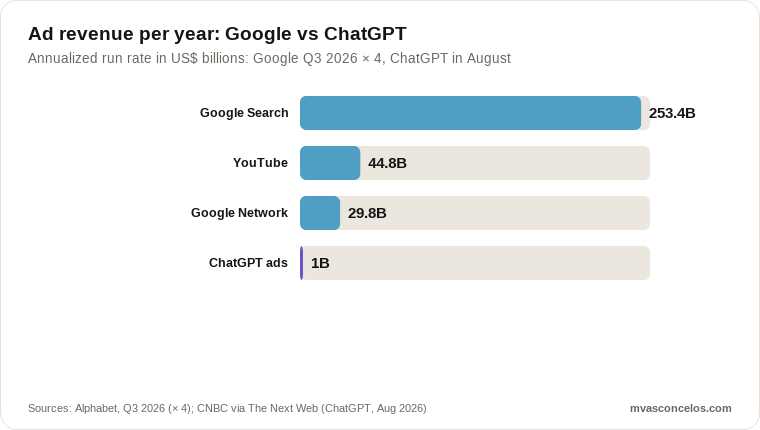
In Q3 2026, Alphabet’s Search & other line brought in US$63.35 billion, up 12% from a year earlier. Multiply by four and you get a pace of more than US$250 billion a year. ChatGPT ads hit a US$1 billion annual run rate in August, according to CNBC. That is very fast growth, but it is still less than 1% of the size of Google search.
(An honest caveat: Alphabet’s line includes ads in Gmail, Maps and the Play Store, not just the search box. Even so, the gap is huge.)
That does not mean nothing is happening. The same earnings report has signals worth watching:
- Search revenue nearly stalled quarter over quarter: it rose only US$79 million from Q2, and year-over-year growth dropped from 19% in Q1 to 12% in Q3.
- More searches, less money per search. Google says search volume grew at its fastest pace in five years. On the earnings call, the company cited lower monetization in AI Mode as one of the reasons revenue grew more slowly than searches.
- Search fell below 50% of Alphabet’s total revenue for the first time, as cloud growth pulled ahead.
In other words: Google is not losing the war to ChatGPT. It is facing the same shift as OpenAI, the move from a list of links to a ready-made answer. And it is putting ads inside the answer too: in October, it brought AI Mode ads to more countries.
Where ChatGPT still falls short
If you advertise, it pays to look past the hype:
- Revenue per visit. A study still under review from the Frankfurt School and the Vienna University of Economics and Business found that a visit from a ChatGPT ad generated 64% less revenue than a visit from a Google search ad, in the US. I covered that study in this article.
- New measurement. The pixel and the Conversions API just arrived. Reliable benchmarks for cost per click and return are still scarce.
- Limited reach. Only people on the free plans or Go see ads. The paying audience, often the most qualified one, sees nothing.
What I would do now
- Do not switch off Google Ads or SEO. The money and the volume are still there. Treat ChatGPT as an extra channel, not a replacement.
- Measure the traffic already coming from ChatGPT. ChatGPT links arrive with
utm_source=chatgpt.com. Filter for it in GA4 and see which pages get visits and whether they convert. - Let OpenAI’s search crawler in. If
OAI-SearchBotis blocked in yourrobots.txt, your site will not show up in ChatGPT’s search answers. - Get your business data ready. Products, prices, hours and answers to common questions, organized and up to date. When ChatGPT’s business area opens, whoever already has this ready gets a head start.
- If you want to test ads, start small. It works best for businesses selling something with a higher ticket and solid conversion tracking. Set a test budget, compare cost per sale with Google’s, and decide with data.
Frequently asked questions
What is ads.openai.com?
It is OpenAI’s Ads Manager, the platform for creating and paying for ads that appear in ChatGPT. It opened as self-serve in the US in May 2026, with cost-per-click or cost-per-thousand-impressions bidding, and in October ads reached 89 countries.
Does OpenAI have a Search Console?
Not officially yet. In November 2026, screenshots surfaced of a business area in development that would show mentions, impressions and clicks in ChatGPT. OpenAI has not announced the product.
Will ChatGPT ads kill Google Ads?
Not in the short term. ChatGPT ads reached a US$1 billion annual run rate in August 2026, while Google search brings in more than US$250 billion a year. What is changing is the format: both are moving ads inside the answer.
Do ads change ChatGPT’s answers?
OpenAI says no: ads appear separately, labeled as sponsored, and conversations are not shared with advertisers. They only show up for people on the Free and Go plans.
My verdict
In nine months, OpenAI built what took Google two decades: an ad platform, CPC bidding, a pixel, dozens of countries and, soon, a dashboard for businesses. That is serious. But in dollars, ChatGPT is still a small fraction of Google.
The end of search is not Google losing to ChatGPT. It is search turning into conversation in both places. If you run a site or buy ads, you do not need to pick a side; you need to be well positioned in both, and to measure where real results actually show up.
What about you? Are you already seeing visits from ChatGPT in your Analytics?
Sources
- Self-serve Ads Manager (May 2026): PPC Land and Search Engine Journal
- Canada, Australia and New Zealand: TechWyse
- 89 countries and 100,000 advertisers: Let’s Data Science
- Search Console-style business area: Search Engine Roundtable
- Alphabet Q3 2026 results: PPC Land, Relevant Audience and Search Engine Roundtable
- Search below 50% of Alphabet’s revenue: Braindetox, using Company Atlas data