Is vibe coding a no-go for businesses? What’s myth, what’s real risk — and the process that makes it work
Raw vibe coding with no review is risky for a business. AI with a process is not. The 2026 data on trust and security in generated code, and the method that works.
Maybe this has happened to you: you asked an AI to build the company website, had something good-looking live in one afternoon, and two weeks later found the form that never sent, the API key exposed in the code or the page that broke on mobile. The conclusion seems obvious: “AI is no good for business.”
Not quite. What is no good for business is raw vibe coding: no review, no tests and nobody accountable for what goes live. Using AI with a process is something else, and it is exactly how I build and maintain my sites today. In this article I separate myth from real risk, show the 2026 data and explain the process that makes AI workable inside a company.
Read also: Is WordPress dying? What the data says for 2027 · will websites stop mattering with AI agents?
What vibe coding is (and why even the person who coined it changed his mind)
The term was coined by Andrej Karpathy, OpenAI cofounder, in February 2025. The idea was to give in to the AI and, in his words, “forget that the code even exists”: you describe what you want, accept what comes back and move on. For a weekend prototype, it is great.
A year later, in February 2026, Karpathy himself said the term no longer covered professional work and proposed another one: agentic engineering. The difference is one of attitude. In vibe coding, the human accepts whatever the AI delivers. In agentic engineering, agents do most of the work, but the human sets the rules, reviews, tests and answers for the result.
That name change says a lot: the people who know the subject best admitted that “going with the vibe” does not scale to real software.
What the data says: everyone uses it, almost nobody trusts it
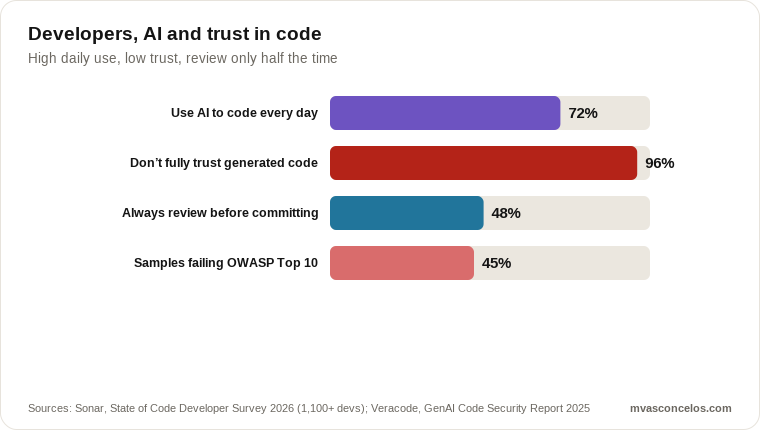
Sonar’s State of Code 2026 survey, with more than 1,100 professional developers, sums up the moment well:
- 72% of developers who have tried AI use it every day;
- AI already accounts for 42% of the code they ship to production;
- 96% do not fully trust that this code is correct;
- and yet only 48% always review it before committing.
On the security side, Veracode’s report on AI-generated code (2025) found flaws from the OWASP Top 10 list, the most common web vulnerabilities, in 45% of the samples tested.
Honestly, the problem is not that AI writes bad code now and then. People do too. The problem is the gap between how much it is used and how much it is checked.
Myth vs real risk
Myth: “AI is no good for business.” It is, and it is already everywhere. Sonar shows that 73% of developers use AI in customer-facing applications. The question is not whether your company will use it, but how.
Myth: “AI does it all by itself, you just ask.” The accounts of people who migrated sites with agents say the opposite: reviewing and testing take longer than generating. An agent is perfectly capable of building the wrong site with all the confidence in the world.
Real risk: code that looks right and is not. In the Sonar survey, most developers agree that AI often produces code that looks correct but is not reliable. Without tests, that only shows up when a customer complains.
Real risk: security. An API key in the code, a form with no spam protection, an outdated dependency, a missing security header. AI does not forget these out of malice. It simply does not know what you did not ask for.
Real risk: nobody understands what went live. If nobody read the code, nobody knows how to fix it when it breaks. That is when the savings turn into debt.
The process that makes it work
This is the process I use on my own projects, including this site. No magic, just discipline:
- Written rules before any code. Every project has an instructions file (
AGENTS.mdorCLAUDE.md) stating what the agent can and cannot do: where credentials live, what never goes into the repository, who approves publishing. The agent reads it before it starts. - Small scope per task. One change at a time, with a clear goal. No “rebuild the whole site.”
- Everything in Git, with a reviewed diff. Every change shows up line by line and can be undone. A site in code, not in a dashboard, is what makes this possible.
- Automated tests. This site has security tests and booking system tests that run before any publish. If they fail, nothing ships.
- Build in a copy, never in the production folder. The agent generates and checks the site in a separate environment.
- Security by default. A Content Security Policy (CSP), bot protection on forms, no third-party script loading without consent.
- A log of every task. One line per change: what was done, where, how it was tested.
- A human approves what goes live. The agent prepares, I review and publish. Always.
That is what Karpathy calls agentic engineering. And it is what separates a site generated in an afternoon from a site that holds up to a company’s day-to-day.
When raw vibe coding is acceptable
To be fair: it has its place.
- A prototype to test an idea with the team or with customers, knowing it goes in the trash afterwards.
- A throwaway internal tool, with no sensitive data and no outside access.
- Learning, to understand what AI can do.
The mistake is taking the prototype and putting it on the company domain as if it were the final product.
Quick checklist for businesses
Before putting anything built with AI live, ask:
- Has someone read the code, and can they explain what it does?
- Is there an automated test for what is critical (forms, payments, login)?
- Are keys and passwords out of the code and the repository?
- Does the site have security headers and spam protection?
- Can you undo the last change in minutes?
- Who answers if it breaks at two in the morning?
If any answer is “I don’t know,” the problem is not the AI. It is the process.
Frequently asked questions
Is vibe coding safe for businesses?
Without review and tests, no. Surveys from 2025 and 2026 show common security flaws in a large share of generated code and little checking before publishing. With rules, human review and automated tests, using AI is workable and already routine on many teams.
What is agentic engineering?
It is the term Andrej Karpathy proposed in February 2026 for the professional use of AI agents: agents do most of the work, but within defined rules, with tests and with a human reviewing and approving the result.
Is building a website with AI and no review dangerous?
It can be. The most common problems are exposed keys, unprotected forms, vulnerable dependencies and code nobody knows how to maintain. For a throwaway prototype, fine; for the company website, no.
Does a small business need this whole process?
It needs a proportional version: written rules, Git, a few tests on what is critical and someone responsible for approving what goes live. It costs little and prevents most of the problems.
My verdict
Vibe coding is not a no-go for businesses. What is a no-go is shipping code nobody read, nobody tested and nobody knows how to fix. With a process, AI stops being a gamble and becomes what it should be: a way to deliver faster without giving up quality.
At least, that is my experience building this way every day.
Sources
- Karpathy, vibe coding (Feb 2025) and agentic engineering (Feb 2026): The New Stack
- Sonar, State of Code Developer Survey 2026
- Veracode, GenAI Code Security Report (2025)
- Accounts of migrations with agents: Half-Built Robots and Wunderlandmedia